My father never called it a vacation. He called it going down. We went down in a faded pickup that smelled of coffee, gasoline, and wet canvas. We went down the last two-lane that seems to forget itself before it remembers the water. And when the road finally quit, there was Port Mansfield — not a resort, not a postcard, just a working little harbor on the edge of one of the rarest lagoons on earth.
I was small enough then that the gunwales of the boat came to my knees. He would lift me in before first light and point east toward the cut they blasted through Padre Island in 1962, the channel that woke this bay and never quite let it sleep again. “Listen,” he would say. Not to me. To the flats. Even a boy can hear a tail slap if the wind is honest and the water is that thin, copper-clear green the Lower Laguna Madre keeps like a secret.
We came every year. We came when the heat still sat on the grass at dawn and the first shrimp boats were only a rumor of lights. We came because August through October is the gathering — the stretch of the calendar when redfish and black drum stop being individuals and start becoming a seasonal migration.
Locals still talk about the redfish parade. From June into August the fish work the west-side lagoons and the skinny water in boot-top depths, tails ticking the surface as they root crabs and shrimp off the bottom. You do not hunt them so much as you wait to be allowed into their morning. Some days that morning belonged to The Saucer. Some days it belonged to the grass along The Oak Motts, or the long drift at the Target Poles, where a boy learned that a named piece of water is really just a promise the old hands keep. You wade. You keep the sun at your back. You learn that a gold spoon or a cocahoe is only the last two inches of a conversation that started with your feet.
By September the tides lift and the fish begin to pod. White shrimp are fat. Crabs rattle in the grass. Along the spoil banks of the East Cut, deposits from the original channel dredging — black drum sweep through in schools so tight they look like weather moving under the water. Mud clouds tell you they were there at first light. We found them on the east edge of The Saucer, working across toward The Target Poles, and again in the potholes off The Oak Motts when the wind laid down. By October the reds are thinking about the pass. They school. They fatten. The late-autumn spawn will happen near the mouths, out toward the Gulf, and the fish know it in their bones the way my father knew the turnoff to town without looking at a sign.
That is the magic, and it has a name if you want one: the Lower Laguna Madre. Hypersaline. Shallow. Guarded on one shoulder by ranch country and on the other by a long, wind-scoured island. From the Land Cut south past Bennie’s Shack, down to The Saucer, The Target Poles, and Three Islands, it is still possible to stand in water that barely covers your ankles and watch a copper-sided fish the length of your arm push a wake like a small boat.
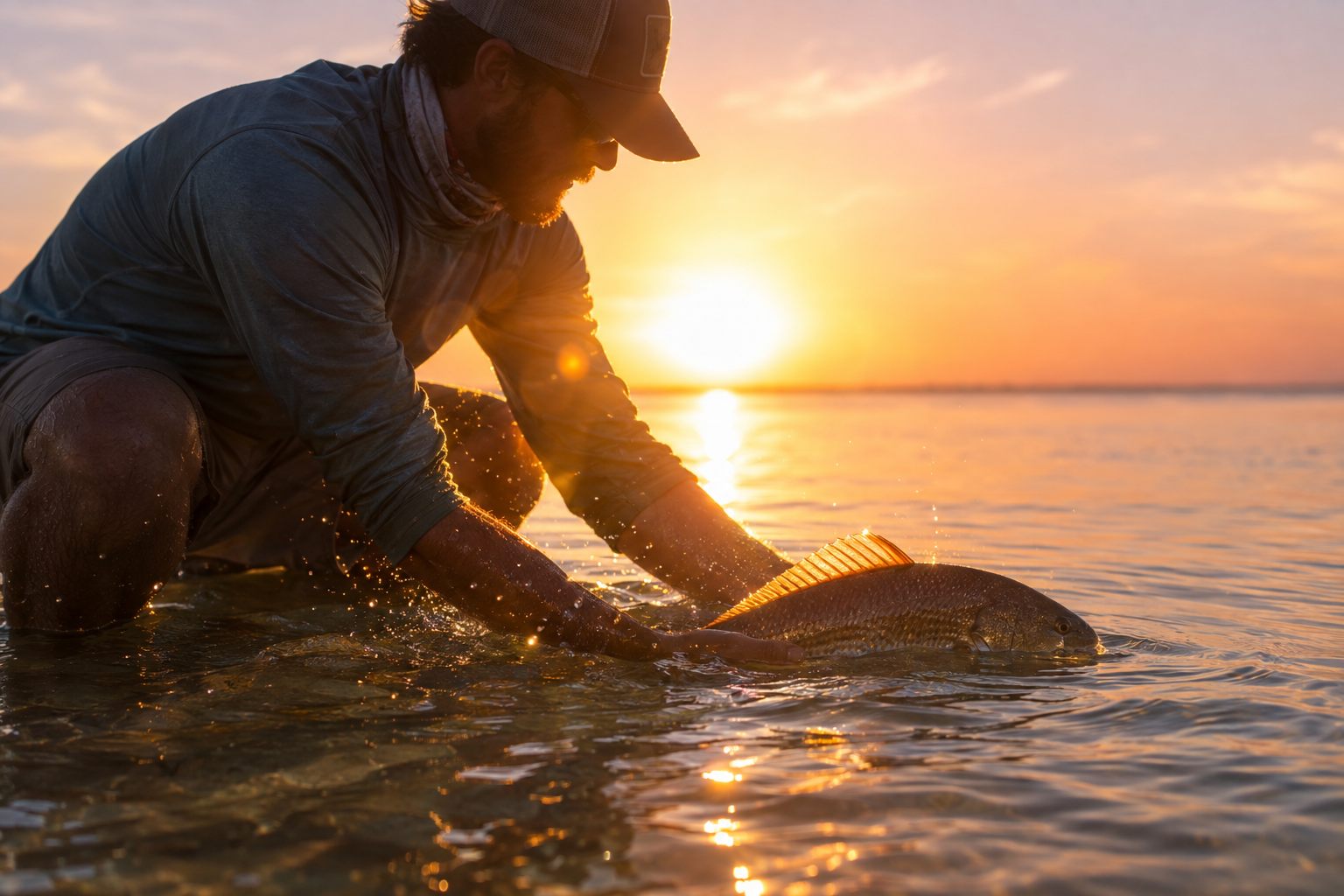
We caught them. We released most of them. Speckled trout went in the ice chest when the evening called for it, and we cooked it the way the little restaurants in town still will if you walk in with a clean fish and an honest face. The bull reds — those heavy, old travelers staging toward the jetties and the deeper guts — we treated like visiting uncles. A photograph. A wet hand on the shoulder. Back they went.
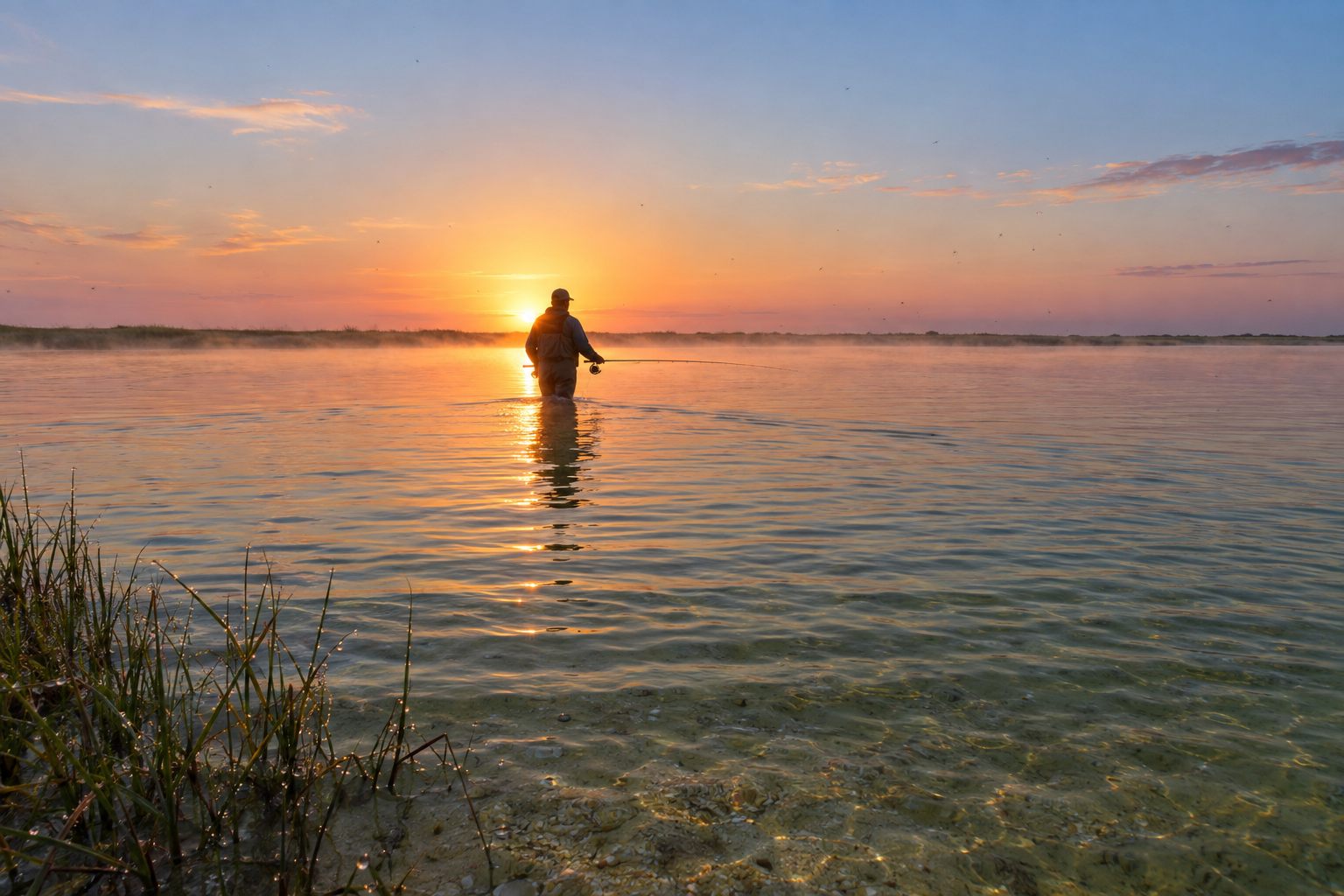
For decades that was the bargain. You earned Port Mansfield. You drove. You rented a cabin that smelled of salt and last year’s sunscreen. You launched in the dark among men who did not talk much before coffee. You fished until the southeast wind stood up and knocked the water into a chop. You ate. You slept the sleep of people who had been in the sun. Then you packed the rods and pointed the truck inland and promised the place you would be back.
My father kept that promise until he couldn’t. After he was gone, I kept it for both of us. The pilgrimage became a habit, then a religion, then — I am not proud of how long this took — a lifestyle.
The town itself never asked me to stay. That is part of its character. Port Mansfield began as Red Fish Landing, a scatter of camps on a bay that belonged more to the fabled Yturria Ranch and the wind than to any map. The port opened in 1950. The cut through the island finished in ’62. The commercial dreams that some men brought here never quite arrived, and what arrived instead was better: a working harbor, a handful of guides, deer in the streets, nilgai out on the El Sauz, shorebirds stitching the flats at first light, and a fishery so clear you can be forgiven for thinking you invented sight-casting.
There is still no traffic worth the name. The horizon is still water and sky. The soundtrack is still wind in coastal grass and, if you are lucky and quiet, the distant splash of a redfish on the flats. Deer cross the road more often than cars do. That is not poetry. That is a Tuesday.
It happened in October, which is right. October is when the bay tells the truth. The air had finally remembered how to cool. Laughing gulls were working shrimp. A herd of reds — that is the local word, herd — moved across a flat south of The Saucer like a single animal with a thousand bronze shoulders. I stood in the water up to my knees and understood, with the simple force of a well-tied knot, that I was tired of packing.
A man can love a place from the highway only so long. At some point the honest thing is to put himself first — not in the cheap way the phrase is used, but in the old way: to give his best hours to the life he actually wants. I had given those hours to offices and inland weather and the idea that paradise is something you visit if you can get the dates right. The fish knew better. They gathered. They committed to the pass. They did not make reservations.
So I moved to Port Mansfield. I joined the little community at the end of the road so the vacation would not have to end — so the boat could live here, so the coffee could be made looking at the same water my father pointed to when I was a boy, so August through October could be a season I walked into from my own door. I did not come to start over. I came to stop leaving.
I did not come to start over. I came to stop leaving.
Now there is a newest chance for people who feel that same pull. On the edge of town, along Gulf, Baffin, and Bayview, they have opened the first phase of a place called New Port. There is no construction on those lots yet. The ground is still waiting for the first house, the first porch light, the first pair of wading boots by a door. I will not dress it up as something it isn’t. It is coastal lots with utilities already at the line, a minute from the ramps, with the ranch on one side and the Laguna wrapping the rest so that nothing crowded can rise up around you. Half of that first phase is already spoken for. The water-closest pieces went early, the way the good holes on a flat go early if you sleep in. There is no waiting list. That feels right for this town. You show up, or you don’t.
I cannot tell you I built there. I can tell you this: if you have been making the same pilgrimage, and you are ready to put your coastal life first and give it a permanent address, New Port is the newest ground in Port Mansfield on which to build that future.
I would tell you that the Lower Laguna Madre in late summer and fall is still one of the last honest sight-fisheries left on the American coast. I would tell you that mud clouds of tailing reds in shin-deep water at The Saucer or along The Target Poles will rearrange your idea of what fishing is for. I would tell you that black drum on the sand in September, and the quiet work around The Oak Motts, will humble a man who thinks he is quiet enough. I would tell you that the jetties and the East Cut will hold bull reds and, on the right afternoon, the kind of tarpon and kingfish that make you forget you ever needed a reason.
I would tell you that Port Mansfield is not for everybody, and that this is the compliment. It is a small harbor at the end of a road, with cook-your-catch kitchens, working captains, and wildlife that has not agreed to become scenery. If you need nightlife, keep driving. If you need the bay at your door and the Gulf an easy run through the cut, you are already late, but not too late.
Mostly I would tell you what my father told me when the truck was pointed south and the thermos was still full: go down. Go while the fish are gathering. Stand in that thin water and watch a place that has refused, for seventy-five years, to become something louder than itself.
And if the morning is good — if the tails keep showing and the wind stays kind — do not be surprised if you start doing the arithmetic I did. How many more Augusts do you want to spend packing a truck? How many Octobers do you want to leave? There is a rare and simple chance, right now, to live inside the pilgrimage instead of commuting to it. The lots will not wait on sentiment. The fish never did.
I make coffee now while the flats are still dark. I can be on the water before the last porch light is turned off. In the evenings the deer come through like they own the deed, which, in a way, they do. Out beyond the grass the lagoon holds its color until the last of the light. Somewhere in that color the reds are shouldering together, pointing themselves toward the pass, keeping an old appointment.
I used to drive a long way to witness it. These days I only have to walk outside. That is the whole story, and it is the only advertisement I know how to write.


400 W. Hidalgo, Suite 200 Raymondville TX 78580

Phone: (956) 689-3332
Phone: (956) 689-2030
Fax: (956) 689-6165
© (year) Website Design & Development by MPC Studios, Inc.